Force-sensitive resistor (FSR)
From SensorWiki
| Sensors | Interfaces | Communications | Tutorials | References |
|
Summary
Introduction
A force-sensitive resistor (alternatively called a force-sensing resistor or simply an FSR) has a variable resistance as a function of applied pressure. In this sense, the term "force-sensitive" is misleading – a more appropriate one would be "pressure-sensitive", since the sensor's output is dependent on the area on the sensor's surface to which force is applied.
These devices are fabricated with elastic material in four layers, consisting of:
- A layer of electrically insulating plastic;
- An active area consisting of a pattern of conductors, which is connected to the leads on the tail to be charged with an electrical voltage;
- A plastic spacer, which includes an opening aligned with the active area, as well as an air vent through the tail;
- A flexible substrate coated with a thick polymer conductive film, aligned with the active area.
When external force is applied to the sensor, the resistive element is deformed against the substrate. Air from the spacer opening is pushed through the air vent in the tail, and the conductive material on the substrate comes into contact with parts of the active area. The more of the active area that touches the conductive element, the lower the resistance. All FSRs exhibit a "switchlike response", meaning some amount of force is necessary to break the sensor's resistance at rest (approximately 1 MΩ), and push it into the measurement range (beginning at approximately 100 KΩ) (Interlink Electronics 2005).
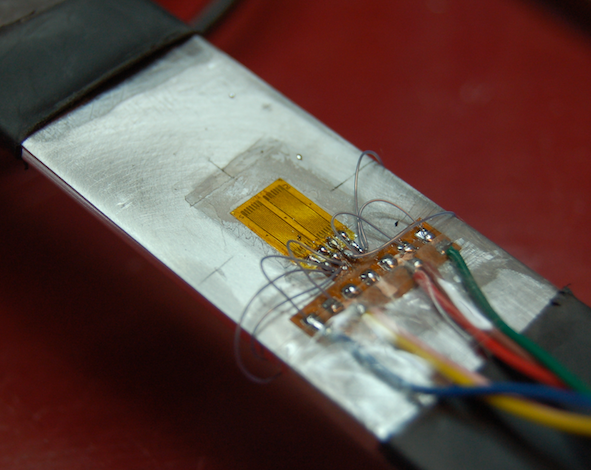
Operationally, an FSR is very similar to a strain gauge, the main difference being that a strain gauge's backing deforms with the resistive element, while an FSR's does not. This fact is important to consider when mounting an FSR against a support, as discussed below.
The same applied force will result in a wider output swing in a FSR than a strain gauge. Strain gauges, however, have higher accuracy than an FSR. Depending upon the particular needs of the application, one may choose one or the other. Ultimately, a major consideration in the choice of a sensor is cost; a major advantage of FSRs is their low cost.
Using an FSR
One of the most common circuits implemented to utilize an FSR's output is the voltage divider. A voltage (usually +5 V) is applied to one of the leads, while the other is grounded. FSRs are not polar, meaning it does not matter which side receives the voltage. One lead from a second resistor (with fixed value) is then connected to the voltage side, while the other lead of the second resistor is also connected to ground. In this way the FSR is able to measure the "voltage drop across a resistor". The resistance value of the second resistor determines the output range of the sensor. Typically, 100 KΩ will yield a sensor output suitable for common ADCs used for musical applications.
Mounting
Because the FSR's operation is dependent on its deformation, it works best when affixed to a support that is firm, flat, and smooth (Burdea 1994). Mounting to a curved surface (as is often the case when placing sensors on the body or clothing, especially on a dataglove) reduces measurement range and resistance drift. One solution is to use a sensor with a smaller active area, since less of the sensing area will be deformed by the contours of the body. Bending the tail will also affect performance because the air vent will be deformed. The tail is also relatively fragile, and if bent far enough the conductive leads inside it will break, rendering the sensor useless and difficult to repair.
Output
The FSR's output signal is a monotonic function of area and pressure. When enough force is applied,this function changes slope quickly due to sensor saturation. After this point output will not be significantly affected by an increase in applied pressure.
This sensor is known to have poor accuracy, with errors up to 25% of output (Burdea 1994).
IDMIL Projects
McGill student interfaces that utilize FSRs:
- Contingence (David Birnbaum)
- Gloves (Pierre-Yves)
- Gyrotyre (Elliot Sinyor)
Devices
Source Country Price Interlink Electronics (http://www.fsrlink.com/) USA National Ergonomic Supply Inc (http://www.nationalergo.com/) Canada Robotshop (http://www.robotshop.ca/) Canada Trossen Robotics (http://www.trossenrobotics.com/) USA
[edit]Interlink Electronics FSR
Force Sensing Resistors
Variants: There are four formats: 0.2" and 0.5" diameter circular, 1.5" x 1.5" square, and 24" long strip
Datasheet: FSR Integration Guide and Evaluation Parts Catalog (http://www.interlinkelectronics.com/library/media/papers/pdf/fsrguide.pdf)
Resources: nice spec summary from Robotshop (http://www.robotshop.ca/content/PDF/interlink-force-sensors-specifications.pdf)
Notes: Prices vary depending on the size and shape of the sensor. See also the "FSR Design Kit" below.
Source Country Price Interlink Electronics (http://www.fsrlink.com/) USA US$100 National Ergonomic Supply Inc (http://www.nationalergo.com/) Canada US$99.95 Robotshop (http://www.robotshop.ca/) Canada CAN$140.26
[edit]Interlink Electronics FSR Design Kit
Contains 4 FSRs of each of the four models: Model 400, 402, 406 and 408 sensors, as well as overlays and adhesives, FSR Integration Guide, Evaluation Parts Catalogue, Technical Notes and Suggested Interface.
Variants:
Datasheet: FSR Integration Guide and Evaluation Parts Catalog (http://www.interlinkelectronics.com/library/media/papers/pdf/fsrguide.pdf)
Resources: nice spec summary from Robotshop (http://www.robotshop.ca/content/PDF/interlink-force-sensors-specifications.pdf)
Notes: Great kit for beginners, except for the waste from the limited range of sizes available!
Source Country Price Trossen Robotics (http://www.trossenrobotics.com/) USA US$16.75
[edit]Tekscan Flexiforce model A201-1
FlexiForce 0-1 lbs. Resistive Force Sensor
Variants: A201-25 (0-25 lb. force range); A201-100 (0-100 lb. force range)
Datasheet: Flexiforce User Manual (http://www.trossenrobotics.com/images/productdownloads/FlexiforceUserManual.pdf)
Resources:
Notes:
Media
|
|
External links & references
- G. Burdea, Force and Touch Feedback for Virtual Reality. New York, NY: Wiley, 1996.
- Interlink Electronics, 2005, "FSR Integration Guide & Evaluation Parts Catalog (http://www.interlinkelectronics.com/library/media/papers/pdf/fsrguide.pdf)", Company brochure, Camarillo, CA, 26 pp.
- FSR info at CNMAT (http://cnmat.berkeley.edu/sensor_module/interlink_force_sensing_resistor)
| Sensors | Interfaces | Communications | Tutorials | References |